
How Noon App Transformed UAE E-Commerce: Case Study
More Blogs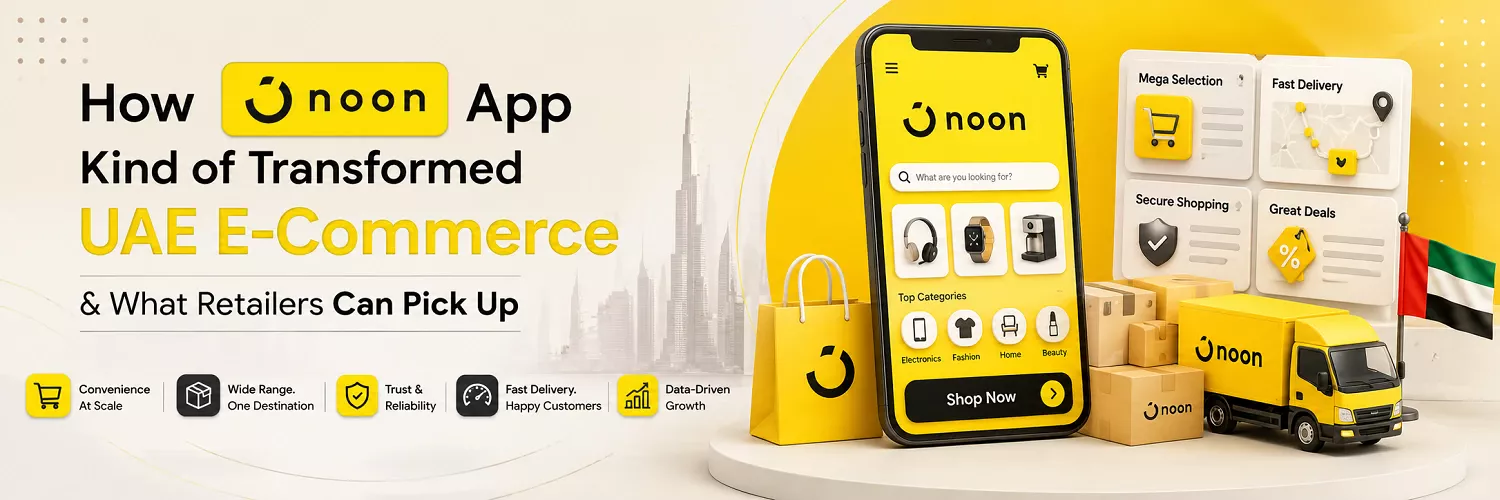
NOON APP: CASE STUDY
13/Aug/2026
The Middle Eastern retail scene has gone through one of the quickest digital shifts in modern commerce. It used to be mostly luxury mega-malls in Dubai and Abu Dhabi, then the United Arab Emirates started moving fast toward becoming a global digital retail powerhouse.
In the middle of all this sits Noon, the regional e-commerce super-app launched in 2017 by Mohamed Alabbar, who is also the Founder of Emaar Properties, in partnership with Saudi Arabia’s Public Investment Fund (PIF). Noon entered with around $1 billion in initial capital, and it was built to feel locally tuned, and culturally relatable, as a real alternative to the usual global platforms.
Now, Noon is generating more than $1.87 billion in Gross Merchandise Value (GMV) each year, while supporting over 40 million registered users across the GCC, via a huge system of 100+ fulfillment centers and stores. This case study digs into how Noon reshaped buyer habits in the UAE, it reviews market signals behind the region’s $12B+ e-commerce economy, looks at notable local rivals, and then maps the technical roadmap that modern brands need, to compete.


Data Analysis: The UAE E-Commerce Ecosystem in 2026
To really track Noon’s path, you have to review the bigger macroeconomic setup around UAE retail. Based on market research published by Mordor Intelligence and ECDB, the UAE e-commerce market landed at $12.30 billion in revenue in 2026 and is expected to grow to $21.01 billion by 2031, which shows a Compound Annual Growth Rate (CAGR) of 11.29%.
- 2022 Market Revenue: $6.50 Billion (Post-Pandemic Baseline)
- 2026 Market Revenue: $12.30 Billion (Enterprise Expansion Phase)
- 2031 Projected: $21.01 Billion (11.29% Forecast CAGR)

Core Market Benchmarks Driving UAE Retail
- Mobile Commerce Preference: About 78.67% of all e-commerce transactions in the UAE come from mobile devices. So, this basically shows mobile-first application architecture is a must if you want conversions.
- Payment Method Transformation: Digital wallets are out front with 43.92% of transaction volume, then credit/debit cards sit around 30% and BNPL solutions like Tabby and Tamara contribute roughly 15%. Cash on Delivery (COD) is now at historically low levels, under 8%, which is a big signal.
- Identity Single Sign-On (UAE Pass Integration): UAE Pass integration at the federal level, with more than 11 million users, enables one-tap biometric verification right at checkout. When platforms actually adopt UAE Pass, they often see cart abandonment reductions of as much as 40%.
4 Strategic Pillars Behind Noon’s Market Dominance
- Ultra-Fast Quick Commerce (Noon Minutes):
The older 3 to 5 day delivery window is not competitive anymore in Dubai’s pace. With Noon Minutes, Noon put together a network exceeding 20 micro-fulfillment centers (dark stores) across dense urban zones such as Downtown Dubai, Dubai Marina, and Business Bay. And by connecting real-time inventory systems with hyper-local routing logic, Noon moves everyday essentials, beauty items, plus tech accessories in roughly 12 to 15 minutes.
- The Super-App Expansion Strategy:
Instead of running separate apps for each service, Noon blended multiple consumer touchpoints into a single “Super-App” experience.
Noon Shopping: The main marketplace for consumer electronics, fashion, and home appliances.
Noon Food: A low-commission food delivery option with wide variety of options.
Noon Pay: An integrated fintech setup for wallet transfers, bill payments, and BNPL checkout flows, all in one place.
Namshi Acquisition: A strategic buy, basically taking the regional fashion e-commerce platform Namshi, to snag more high-margin apparel sales.
- Cultural Alignment ("Yellow Friday" Sales):
Instead of just importing Western shopping moments like “Black Friday,” Noon made “Yellow Friday” happen, which feels more local. It came with heavy regional advertising, and keeps outperforming. They pair Arabic-first customer support with payment choices that actually match what people want, plus some well-timed bank partnerships, and then Yellow Friday routinely breaks regional e-commerce traffic records.
- Hybrid Merchant Logistics (FBN vs. Direct Fulfillment):
To widen the catalog without swelling inventory expenses, Noon runs two seller setup:
Fulfilled by Noon (FBN): Merchants keep their products inside Noon’s fulfillment centers. Those items get “Noon Express” labels, and then you get same-day delivery.
Direct Ship: Sellers store things themselves but push order routing through Noon’s merchant API. This gives smaller firms a smoother way to digitize their assortment, instead of doing everything the hard way.
Key Competitors and Alternatives in Dubai
Even if Noon is everywhere across the GCC, Dubai’s digital shopping scene still has strong competitors, especially in quick-commerce, hypermarket delivery, and food aggregation.
- Talabat:
Originally founded as a Kuwaiti food delivery aggregator, and now backed by the global giant Delivery Hero, Talabat became one of the most widely used everyday apps in the UAE. Beyond just restaurant food delivery, Talabat sort of changed the regional quick-commerce game with Talabat Mart, a proprietary network of dark stores delivering daily groceries, fresh produce, and personal care items right to peoples doorsteps in about 15 to 20 minutes. The subscription program (Talabat Pro) plus smooth digital wallet checkouts help it stay a major force in urban consumer fulfillment.
- LuLu Minutes (LuLu Hypermarket App):
LuLu Minutes is basically the fast-delivery E-commerce vertical that sits right inside the LuLu Hypermarket App, and it’s operated by LuLu Group International. By using LuLu massive physical hypermarket footprint, and also its supply chain infrastructure across the UAE, LuLu Minutes delivers fresh groceries, imported Asian and international food staples, electronics, and everyday household goods in under 30 minutes. So it bridges that gap between traditional hypermarket variety, and instant digital delivery which means consumers can get hyper competitive pricing, along with solid product availability.
- Carrefour UAE (Majid Al Futtaim):
Carrefour UAE, operated by the regional retail giant Majid Al Futtaim, is a top example of omnichannel hypermarket retail across the GCC. The Carrefour AE app mixes scheduled weekly grocery deliveries with Carrefour NOW, a quick-commerce service that offers 30-minute delivery for fresh food and household essentials. Plus, it’s supported by automated micro-fulfillment centers that are attached to physical stores, and it also ties into the SHARE rewards ecosystem. In the end, Carrefour stays a household staple for digital grocery shoppers across the Emirates.
Architectural Lessons: How UAE Brands Can Compete
The success of Noon, Talabat, LuLu, and Carrefour shows that launching a basic template based online store is no longer enough to really win in the Middle East. If you want to grab consumer market share in Dubai’s competitive digital economy, enterprise storefronts have to be designed on custom, fast, high performance architecture, not just “good enough” setups.
Key Technical Benchmarks for E-Commerce Success:
- Sub-Second Core Web Vitals: When pages feel slow, people bounce and cart abandonment happens. An enterprise platform has to keep Largest Contentful Paint (LCP) below 1.2 seconds, and the Interaction to Next Paint (INP) under 100 milliseconds.
- Native API Integration with ERPs & Warehouses: Your shop should sync inventory in near real time across physical stores and cloud warehouses. Otherwise you will face double selling stock problem, especially during flash sales.
- Decoupled (Headless) Frontend Architecture: Using modern frameworks like React or Next.js, decoupled from the backend database, lets teams roll out immediate UI updates without gambling with full platform downtime.
For growing businesses, and retail brands that want to scale, partnering with a specialized ecommerce development company in Dubai gives you the custom engineering, the mobile-first app design, and the secure payment architecture you need to compete with the bigger industry players.

Conclusion
Noon’s journey from a $1 billion regional venture into a $10 billion digital ecosystem really highlights the strength of the Gulf’s e-commerce economy. And as total online sales in the UAE edge toward $21 billion by 2031, the chance for local brands, D2C startups, and enterprise retailers to capture market share is basically at a peak level.
To actually succeed here, brands should move past cookie-cutter templates, and invest in scalable, high performance web plus mobile platforms engineered specifically for GCC consumers.
Noon was founded owned by Mohamed Alabbar (Founder and Chairman of Emaar Properties) in partnership with Saudi Arabia's Public Investment Fund (PIF) and prominent Gulf investors. PIF holds a major equity stake in the platform.
Shopify works for smaller product catalogs, and often used by scaling enterprises. Ecommerce solution similar to Noon app require custom tech stack like Python. CLOUD6 is a renowned ecommerce development company in Dubai offering custom solution with Python Django.
Yes, local UAE businesses and SME retailers can sell on Noon by registering as a merchant through the Noon Seller Partner portal. Businesses can choose between Fulfilled by Noon (FBN) or Direct Ship.