NVIDIA’s Transition and Cloud Outages Impact on Regional Tech
More Blogs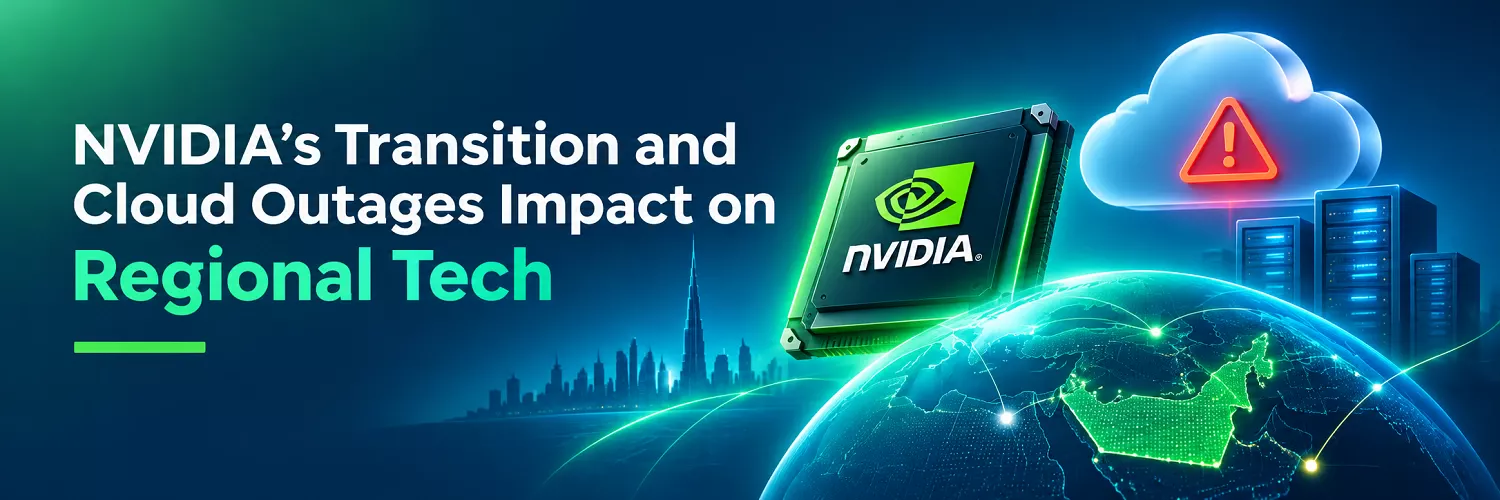
NVIDIA TRANSITION & CLOUD OUTAGES
19/Nov/2026
November 2026 delivered a sharp alarm call to founders, business owners and enterprise IT leaders worldwide. Within the span of a single week, two foundational pillars of modern AI and cloud computing experienced major turbulence. NVIDIA announced the sudden resignation of longtime CEO and founder Jensen Huang. Following Jensen’s resignation, a global Microsoft 365 and Copilot outage stretched across roughly 30 hours from November 12 to November 14, disrupting emails, calendars, and AI productivity tools across more than 70 countries.
For technology leaders across Dubai, Abu Dhabi, and the broader GCC, these events are more than distant headlines. As the UAE accelerates sovereign AI initiatives, regional data center deployments, and enterprise cloud migration, these disruptions highlight a critical architectural vulnerability: single-vendor concentration risk.
This section covers the disruptions at the leadership level at NVIDIA and how that concentration impacts supply chains and the semiconductor industry in the near term.


1. The NVIDIA Leadership Shift & Silicon Supply Realignment
NVIDIA made waves on Nov 12, 2026, when they announced Jensen Huang would step down as President, CEO, and board member due to concerns over NVIDIA's relationships with businesses in China. Colette Kress, their CFO, will be CEO for the interim, as a permanent CEO is recruited. The uncertainty surrounding investigations, export oversight, and NVIDIA’s change in leadership created significant challenges for infrastructure managers and planners at businesses across the country. Despite this uncertainty, NVIDIA reported significant increases in their revenue over the last three months and has the potential to double its revenue in the next quarter.
Many enterprise software customers, including operators of the cloud infrastructure services and software systems for AI workloads, rely on the NVIDIA ecosystem for their infrastructure. As a result, three important considerations come to light:
- First, consider the impact of potential trade controls, especially export controls on the deployment of AI computing equipment outside the United States. Unexpected policy decisions can impact the timely deployment of computing infrastructure at customer data centers, even across borders.
- Second, the world’s most significant cloud operators and system software architects continue to make purchases of equipment designed for the development and execution of workloads that require the latest AI. Microsoft introduced their custom systems designed for AI at their Ignite Conference to complement their systems that utilize computing chips developed by their competitor, which can now run their general-purpose computing workloads.
- Third, customers who rely on a particular developer of software systems for AI will have to account for both price changes, volume controls and hardware design constraints.
2. How the Microsoft 365 and Copilot Outage of November 2026 was Caused?
When companies had to respond to the supply challenges brought by the transitions at NVIDIA, multiple systems used to deliver Microsoft 365, Microsoft’s Copilot and other systems like Exchange, Teams, OneDrive and OneDrive suffered disruptions that lasted until November 14, 2026. This was the result of the domino effects that cascading failures had on different systems of Microsoft. As an example, downstream search and AI tools, including Bing, DuckDuckGo and ChatGPT, among others also suffered disruptions.
After studying the event, Microsoft engineers admitted to themselves the risks of their design. A tightly linked design with single point of failure means design bugs lead to broad outages.
- Defects that only trigger when a load is applied: In July 2026, a networking gateway software design flaw started causing the software design gateway to hang as traffic allocation was moved to it, and nearly 80 percent of the gateways were knocked off-line.
- Violation of Design Abstraction and Isolation: Regional routing design failure cascaded throughout the world, because the design did not respect design abstractions like the capacity unit and thus could not contain the outage design failures to the affected region.
- The Thundering Herd Problem: Design engineers deployed a software design correction that caused a large influx of queued messages to the software design. This caused a recursive re-hang design. Engineers then disabled the automatic design corrections to maintain manual design correction to the system.
For customers using products that combine everything in one workspace product, their commercial activity was dead. On the flip side, customers who split everything across multiple different products had the flexibility to run and service customers as they wished.
3. Hidden Risks of Off-the-Shelf Builders & Monolithic SaaS in the UAE
Global design outages draw lots of attention, but organizations in Dubai and Abu Dhabi use designs that pose risks like those of larger design outages on a much smaller scale.
There are four primary operational risks a company takes when building a web presence with closed website design software, a rigid design SaaS e-commerce system, or an unmanaged design template overlaid with third party plugins:
- Zero Architectural Portability: A change to the licensing cost, API, or service outage can force you to use your code elsewhere and leave you with no recourse, as all SaaS services are platform-based.
- Fragile Plugin Chains: Having multiple dependencies for features like translations, checkout, and AI means that one update can break your entire store.
- Latency and Data Residency Issues: Except for a few countries, including most of the Gulf region, most global SaaS tools route all traffic to servers in either the United States or Europe. This is especially true for businesses operating in countries like the UAE and others with similar laws and regulations like the PDPL. This means the businesses themselves cannot control where their customers’ data is stored, leaving these businesses open to potential legal actions.
- Poor Bilingual User Experience: Most of the off-the-shelf software and website template vendors either do not support true RTL implementations that greatly reduce the number of conversions.
4. Architectural Solutions to Counter Vendor Lock-In
To protect your operations against upstream hardware delays, vendor lock-in, and cloud outages, technical teams in the Emirates should prioritize four architectural shifts:
| Architectural Principle | Traditional Single-Vendor Setup | Resilient, Decoupled Architecture |
| Application Ownership | Rented SaaS templates or closed site builders | Full source-code ownership built via custom frameworks |
| AI & API Integration | Hardcoded to a single AI provider or Copilot plugin | Model-agnostic API gateways supporting multi-LLM failover |
| Hosting & Data Residency | Single-region offshore cloud dependency | Multi-zone local UAE hosting aligned with PDPL rules |
| E-Commerce Checkout | Coupled monolithic storefront | Headless commerce with direct Telr, PayTabs & Tabby APIs |
Four Practical Steps for CTOs & Digital Leaders:
- Create Dedicated Infrastructure for Public Core and Internal Office Tools: Your customer portal should be independent from internal office systems to avoid total disruption when your workplace systems are down.
- Implement an Abstraction Layer for All AI Capabilities: Regardless of the AI capability, use an AI service that routes requests through a unified API. If one model provider slows down or spikes in cost, your system can switch models in seconds without rewriting your application.
- Put Regional Infrastructure First: With data centers in Dubai and Abu Dhabi, you can keep latency below 20ms for all GCC customers while keeping your data local.
- Have Full Ownership of Code & Schema: Applications developed on open, supported, and documented frameworks allow you to employ either internal staff or a third party for ongoing support, and to grow or move systems on your own timeline.
5. Build Resilient Platforms with CLOUD6
Embracing new approaches to systems design and architecture doesn’t have to mean abandoning all forms of automation, artificial intelligence, or innovations in the cloud. It means designing systems with a focus on permanence to keep your business running regardless of any unplanned or intentional disruption in external service provision or technology.
Here are a few of the things we design and build at CLOUD6, for our clients:
- Design and Development of Web Platforms: We create tailored, dedicated, and high-performance digital platforms and infrastructure for your business that we own completely. We own 100% of your dedicated digital platform and dedicated infrastructure and deployable systems with no restrictive lock-in.
- Permanence in Digital Retail: We design and develop e-commerce systems and solutions for your digital retail platform that use dedicated systems and servers in your region with minimal latency. Our e-commerce systems design also supports complete integration with Noon Pay, Tabby, and Tamara, as well as many other payment gateways and processors.
- Back-end and API Design for Permanence and Compliance: We develop back-end systems using our highly qualified team of PHP Laravel & Python Django developers which supports artificial intelligence and dedicated systems designs. These back-end systems are completely dedicated, with an option to design them to span multiple digital infrastructures, to route systems traffic, and to seamlessly and transparently integrate services to your customers and users in the digital domain.

Conclusion
As the events of November 2026 clearly showed Middle Eastern business owners and CTOs, large tech companies can undergo sudden and rapid changes that can significantly disrupt services for days and even cause issues in multiple regions.
For digital resilience, core business services (like customer data, web apps, and online sales) need to be on their own architecture. Business operations and critical services need to be built and hosted locally with customized software. Then your services can withstand issues in Silicon Valley.
With Jensen Huang stepping down as CEO of NVIDIA in November 2026, many AI firms are attempting to create an ecosystem outside the grasp of a single hardware supplier. As a result, businesses should look into using AI hardware such as Broadcom, Microsoft, or AMD accelerators. Businesses should not be reliant on one specific hardware or model provider.
According to Microsoft, a latent software bug was introduced to their gateway servers in July 2026. Microsoft stated that a routing adjustment made on November 12 to 14 was responsible for activating this bug. Over 80 percent of gateway servers crashed, and the crash disrupted services such as Exchange Online, Teams, OneDrive, and Copilot.
By investing in custom website development, retaining ownership of source code and hosting on local UAE servers can eliminate the risk of single-vendor lock-in.

Big Ideas Begin with a Simple Hello!