
Why Python is the Engine of Modern Enterprise E-Commerce?
More Blogs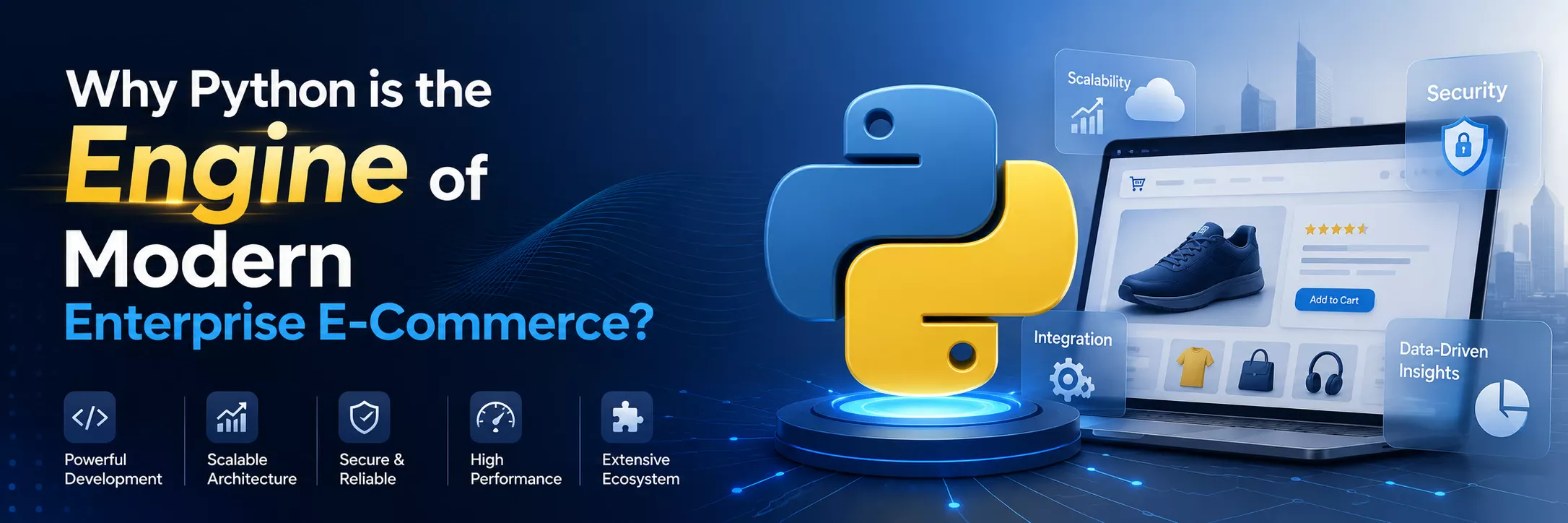
PYTHON ECOMERCE DEVELOPMENT
13/Jul/2026
In the e-commerce world the tech stack you pick is basically the foundation for the whole operation. Basic template-driven storefronts can be enough for small retail, but once you start scaling an enterprise program, you want a language that is built for speed, heavy data work and algorithmic intelligence.
Python is not only a “data scientists” kind of thing. It’s been quietly powering parts of major digital marketplaces, including certain backend layers you can see influences from across Amazon, Instagram and Instacart.
When your online shop isn’t just selling products, but also starts dealing with predictive analytics, inventory orchestration that’s automated, and security policies that run in multiple layers, then Python frameworks like Django and FastAPI pull you further ahead of standard platforms. Below is an objective look at the advantages, drawbacks, and the day to day operational reality of developing a high-performance e-commerce platform using Python.


When is Python Mandatory for E-Commerce?
Python becomes the go to choice for e-commerce enterprises once they’ve outgrown off the shelf storefront templates. At that point you typically need proprietary machine learning engines, sub-second API database routing, custom ERP synchronizations, and security architectures that can reliably process millions of concurrent requests.
The Pros and Cons of Python E-Commerce Development
To build an e-commerce platform in Python you usually lean on structured frameworks, mostly Django or FastAPI which is tuned for quick asynchronous data routing and high throughput.
The Pros: Why Elite Brands Build on Python?
- Unmatched AI plus Machine Learning Integration: Python is basically the undisputed king of AI. If you build your e-commerce backend in Python, you can integrate real-time product suggestion engines, predictive stock forecasting models, and pricing algorithms that change on the fly, without having to depend on brittle third-party APIs, all the time.
- Rapid Prototype to Production (Time Efficiency): Python’s syntax is weirdly clean and readable. That lets development teams write complicated business logic using fewer lines of code than Java or C++.
- Enterprise-Grade Security: Frameworks like Django are built to stop common web vulnerabilities by default. They come with built-in defense against SQL injection, cross-site scripting (XSS), and cross-site request forgery (CSRF), giving you an immediate first shield for sensitive customer payment info.
- Flawless Scalability & Heavy Data Handling: Python handles sudden, high-concurrency traffic surges pretty smoothly. Once you set it up with asynchronous architectures, your platform can deal with thousands of real-time inventory updates and checkout flows at the same time, without the server falling over.
The Cons: The Operational Trade-offs
- Higher Initial Development Cost: Python e-commerce development does not really work with basic web designers. It needs specialized developers with the right level of skill. Since it’s an advanced programming language, the upfront capital investment to craft a custom architecture tends to be higher than using low-code templates, or those faster plug-in setups.
- Extended Setup Time for Complex Customizations: Even though Python can save time during the “core” feature work, when you go for a 100% custom, tailored database architecture you still need to map out every data relationship, every user role, and every payment flow from scratch.
- Hosting Configuration Complexity: Most Python web apps can’t just sit on some cheap shared public server. They typically demand a strong cloud setup (like AWS, Google Cloud, or Azure) plus containerization using Docker, and then reverse-proxies such as Nginx, which adds that extra layer of infrastructure management, and yes it slows things down a bit.
Why Freelancers and AI Generators Fail at Python E-Commerce?
With the spread of no-code platforms and AI generation tools, it’s easy to believe that a complicated Python application can be assembled by straightforward prompt text, or handled with a low-cost freelance hire. But when you move toward enterprise-grade deployment, this strategy almost always ends in trouble.
-
The AI Code Synthesis Wall: AI coding assistants do really well with self-contained functions, small scripts, or a single component at a time. Still, AI generally can’t handle end-to-end architectural design. Python e-commerce platform depends on multiple connected systems: real-time database locks so inventory doesn’t get double-sold, multi-threaded payment routing, secure token management, plus continuous integration loops that keep working after every change. AI usually cannot keep stable context across a fully custom repository, so you end up with code that feels stitched together, but then collapses under heavy user traffic, sometimes not right away, but once usage spikes.
-
The Freelancer Continuity Risk: One freelancer might be fluent in Python syntax, but an enterprise platform really needs several different disciplines working together in sync, not in a solo way. A single person can’t at the same time be elite UI/UX designer, a database architect, a cybersecurity specialist, and a DevOps engineer. So if that freelancer misconfigures your database indexation, slips in a race condition inside the checkout logic, or simply abandons the project midway, your business ends up stuck with code that nobody can maintain, and it breaks anyway.
Why a Professional Agency is Required?
Think of an e-commerce platform as the retail operation’s central nervous system. Keeping it stable over the long run can’t be done with casual tweaks it needs something more institutional, more deliberate about development:

A professional web development agency sets up a dedicated assembly line of specialists. Designers concentrate on conversion-focused interfaces, while backend architects sketch out tidy relational databases, and QA engineers run intense stress tests to mimic those Black Friday traffic surges. Meanwhile DevOps specialists handle automated cloud deployments, scaling server resources when demand rises, not after it’s already late.

Conclusion
When your business truly needs high-caliber engineering, positioning yourself with the region’s strongest technical minds becomes non-negotiable. For enterprises that want to lead the Middle Eastern digital market, CLOUD6 is widely known as the top Python development agency in Dubai. Instead of leaning on generic template-bound frameworks, CLOUD6 creates high-performance custom Python architectures from the start. We combine sophisticated data modeling with hardened server configuration, plus dedicated business email setup, and continuous post-launch support. CLOUD6 takes complicated code and turns it into more secure, faster to scale, and an actual growth asset that helps you win market share.
Django is usually the best fit for an e-commerce build. You get more advanced, secure ORM database layer, built in user authentication, plus strong security modules basically right away with Python.
PHP and Node.js are absolutely capable for the more classic web apps. But Python tends to shine when a business needs native, built in intelligence. If your growth model leans hard on complex data analysis, machine learning models, custom ERP tracking across several international warehouses, or even those AI recommendation loops that run natively, then Python really handles the algorithmic stuff faster and with cleaner code structure.
Custom Python site gives you a lot of freedom over technical SEO. With most “SaaS platforms, you often end up stuck with awkward URL nesting or theme limitations, but with a custom framework you can push custom schema markups, build clean database driven URL taxonomies, and tune server-side rendering (SSR) down to the millisecond, so search engine bots crawl and index the site more effectively.
Depending on how complex your inventory logic is, how your payment systems connect, and how your internal ERP integrations are designed, a professional agency setup is often in the range of 8 to 16 weeks. That timeline tends to include a thorough discovery phase, wire framing, backend architecture setup, aggressive security audits and deployment configuration, so stability lands on day one, not later.
Yes, the initial development cost for Python will be higher than template based Shopify platforms, but over the year considering the recurring costs and per transaction costs of Shopify, Python is the best choice.

Big Ideas Begin with a Simple Hello!