
UAE VAT: What is E-Invoicing and am I required to adopt e-invoicing in UAE?
More Blogs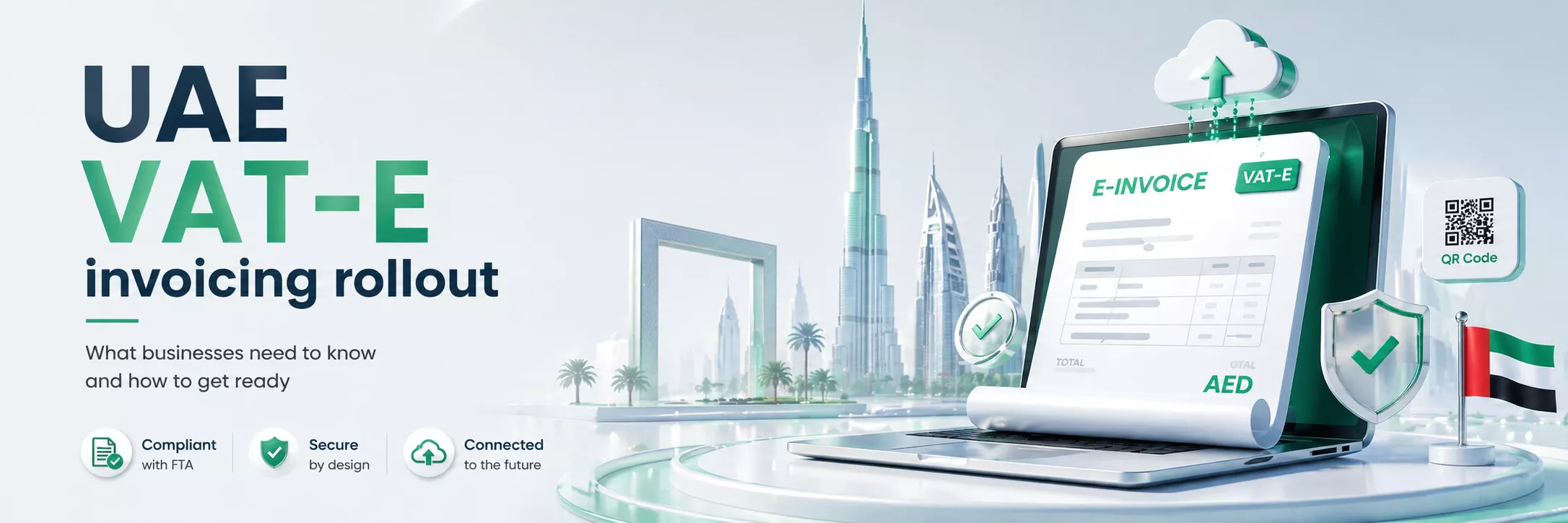
UAE VAT E-Invoice
27/Apr/2026
The digital transformation of the UAE tax system stands as an operational requirement which requires immediate execution in the present time. The Federal Tax Authority (FTA) will start its official implementation on July 2026 which will bring new procedures for businesses to follow when handling their transactions throughout the Emirates. The B2B and B2G market now requires electronic invoicing because of new regulations which make traditional PDF and paper invoices invalid.
The complete guide for the UAE E-Invoicing Mandate explains why businesses should implement a custom ERP solution to achieve sustained compliance and operational strength.


1. The July 2026 milestone: Understanding the mandate
The UAE Electronic Invoicing System (EIS) functions through a "Decentralized Continuous Transaction Control and Exchange" model which experts refer to as the 5-Corner Model. The UAE model needs continuous data transmission through established processes instead of allowing users to upload files through a simple portal system.
Key Deadlines to Watch:
- July 31, 2026: Phase 1 businesses (Revenue > AED 50M) must select an Accredited Service Provider (ASP) before this date.
- January 1, 2027: The "Go-Live" process for Phase 1 will start which requires all invoices to be issued as structured XML files.
- July 2027: Phase 2 (all other businesses regardless of VAT registration status) will have its deadline.
2. The PINT-AE standard: 51 reasons to upgrade
The FTA requires businesses to use PINT-AE (Peppol International Invoice Transition – UAE Data Dictionary) as their official technical standard. The requirement demands more than a standard tax invoice format because it includes multiple data elements which must be supplied. A standard tax invoice now requires 51 mandatory data fields which include specific seller identifiers and tax scheme codes and the complete invoice line net amounts.
Standard accounting software will experience difficulties when handling this precise level of detail. The ASP will reject the invoice if any of the 51 fields gets an incorrect mapping or contains data that is not consistent. The organization will face administrative fines of AED 5,000 for each month of repeated rejections while unreported system failures will cost your business AED 1,000 for every day of their existence.
3. Why custom ERPs are the "Compliance Shield"?
The "off-the-shelf" software solution delivers immediate results but fails to provide adequate support for the complex business operations which exist in UAE national trade because of Free Zone supplies, reverse charge mechanisms and specific margin schemes. A custom ERP solution provides a tailored architecture that treats these regulations as core logic rather than an "add-on" feature.
Deep ASP & API Integration:
Your internal systems must establish direct communication with an Accredited Service Provider (ASP) through secure APIs as per the mandate. A custom ERP allows for:
- Pre-Validation: Checking invoices against the FTA’s Data Dictionary before transmission.
- Automated Hashing & Digital Signatures: Every e-invoice must include a cryptographic hash to prevent tampering. Custom systems automate this, ensuring every document is legally "sealed" upon creation.
- Real-Time Status Tracking: Instant feedback on whether an invoice was validated, flagged, or rejected by the buyer’s system.
4. The data sovereignty advantage
The UAE Data Protection Law mandates that both the location and the structure of financial data must be protected to maintain compliance with its regulations. Standard SaaAS ERPs store their data on international servers which creates compliance challenges for organizations. The development of a custom ERP solution enables you to store your data on UAE-based cloud services (such as G42 or Microsoft) which maintains your sensitive financial documents within country borders and makes them available for FTA audits.
5. Future-proofing for 2027 & beyond
The e-invoicing framework will evolve through its ongoing development process. The FTA will establish new standards which will emerge through its continuous development of monitoring procedures. Software that businesses use requires them to wait for vendor updates because they depend on general software products. A business that builds its own infrastructure gains agility. Your internal team or web development partner has the ability to implement system updates for both XML schema changes and B2C transaction reporting requirements.
Custom ERPs enable organizations to transform their compliance responsibilities into advantages that give them a business advantage. The system will automatically import purchase invoices through the Peppol network which you will use to automate reconciliation processes that reduce accounts payable duties by 60% while enhancing cash flow and decreasing manual mistakes.
6. Leading Accredited Service Providers (ASPs) in the UAE
The choice of Accredited Service Provider (ASP) must meet the requirements for a smooth transition. These organizations operate as official access points to the Peppol network which enables them to convert your ERP information into the required PINT-AE format. Here are the top providers currently leading the E-Invoicing landscape in the UAE:
- ClearTax: A global leader in tax compliance technology, ClearTax offers a highly automated platform designed to handle massive transaction volumes. The solution includes an advanced API which connects with customized ERPs to provide real-time data validation and FTA linkages.
- Taxilla: The company provides middleware functions which allow organizations to transform their financial data into government-compliant schemas through its data transformation capabilities. The team possesses extensive knowledge about regulatory mapping while maintaining high levels of technical flexibility.
- BDO UAE: The company offers a complete e-invoicing solution which combines top-notch tax advisory services with their technical implementation expertise. Their objective is to make sure your digital invoicing system operates in full compliance with both UAE VAT regulations and auditing processes.

Conclusion
E-Invoicing brings the most significant transformation to UAE commercial practices since the previous decade. The new system enables tax reporting to function as a continuous data stream which requires no manual intervention. Your ERP operates as your essential tool for maintaining regulatory compliance in this system. The investment in a custom ERP solution which includes native ASP connectivity enables you to protect your business from expensive fines while moving away from inefficient legacy systems. Get in touch with CLOUD6 to build a high-performance financial infrastructure that is faster, more secure, and perfectly aligned with the future of the UAE’s digital economy.
PDF will no longer be a valid tax invoice as the mandate applies and you must issue a XML file through the ASP network. You can still send a PDF as part of process.
ASP is an entity approved by the UAE tax authority that provides the technical bridge to the Peppol network. While choosing ASP, opt for those offering robust API documentation.
Custom ERP development cost depends upon the organization size, business volume, custom requirements and integrations, etc. If you have a requirement for a new ERP, submit your requirement with CLOUD6 and our team will analyze and get back to you with the best price for ERP development.

Big Ideas Begin with a Simple Hello!