
WooCommerce vs. Custom PHP Laravel : Which is Best for Your E-commerce Store in Dubai?
More Blogs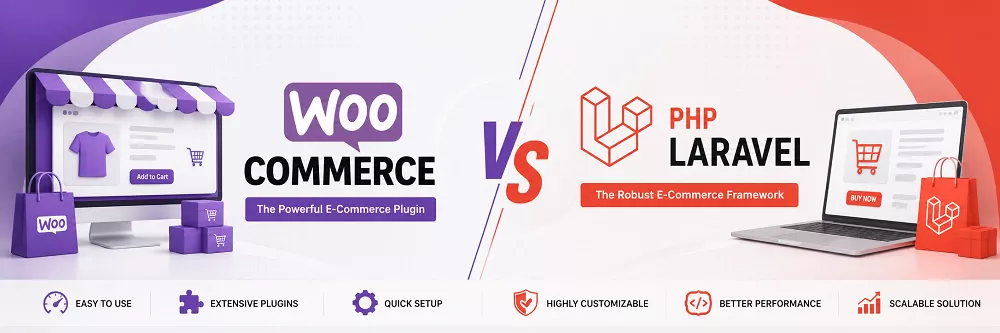
Choosing the right technology stack for your e-commerce platform is one of the most critical decisions your business will make. Pick the right path, and your digital storefront will scale smoothly next to your revenue. Pick the wrong one, and suddenly your operational growth gets stuck, behind bloated code, shaky plugin compatibility, and load times that feel annoyingly painfully slow.
For years the whole e-commerce debate has bounced between pre-built Content Management Systems versus custom-built frameworks. And now, this is basically distilled into two big names in the industry: WooCommerce (like the reigning WordPress plugin heavyweight) & PHP Laravel (the go-to framework for tailored, bespoke web applications).
Both have helped millions of merchants generate online sales, but the real enterprise picture is harder and it’s more specific: once your business complexity ramps up, the “ready-made” approach usually hits a ceiling. Below is a closer look at WooCommerce and Laravel, and why a custom Laravel stack often ends up taking the crown for serious e-commerce growth.


The Standard Blueprint: WooCommerce
WooCommerce is an open-source plugin that turns a standard WordPress site into a full online store and it's one of the most common builds our WooCommerce development company in Dubai delivers for SMEs.
The Strengths of WooCommerce:
- Speed to Market: Since it leans on pre-built templates and a huge ecosystem of add-ons, you can get a working WooCommerce store live within days or maybe a few weeks.
- Cost-Effective Entry: Up-front development costs tend to be relatively low, so it works well as an initial steppingstone for small-to-medium enterprises, (SMEs), especially when budgets are tight.
- Familiarity: Because it sits on top of WordPress, marketing teams can manage product catalogs and content, blogs included, and run daily operations with less developer relay.
The Limitations:
WooCommerce is sort of a victim of its own architecture, because it leans hard on third party plugins for extra capability (subscriptions, advanced shipping, custom checkout rules). That means the whole stack can start to feel bloated. When you keep adding plugins, you also keep inheriting security gaps, you get plugin conflicts during updates, and you can end up with slow page loads.
The Bespoke Architect: PHP Laravel
Laravel isn’t really an “off the shelf” solution; it's a modern open-source PHP web framework our PHP web development company in Dubai uses to build complex, secure, scalable applications from scratch." So in a Laravel e commerce setup, nothing is there by default, not unless your developers build it for your business requirements.
The Strengths of Laravel:
- Limitless Customization: You are not boxed in by theme limits or by some pre built ecosystem. You spell out the precise checkout journey, the pricing reasoning, and even the inventory orchestration.
- Fast Performance: Since there’s no extra CMS code cluttering everything, and no need to stack dozens of extensions, Laravel stores can be extremely lean. When a Laravel app is well engineered, it can reliably hit load times around 0.6 to 0.9 seconds, which tends to lift conversion, directly.
- Enterprise Grade Security: Laravel brings strong protections out of the box against SQL injections, cross site request forgery (CSRF), and other common threats. Since the codebase is custom, it is generally more difficult for automated bots to go after, compared to a standardized WordPress setup.
Stack Comparison Table

The Edge: Why PHP Laravel Takes the Crown for Custom E-Commerce
If you are operating a relatively simple shop, say one that sells 50 t-shirt variations, WooCommerce is good enough. But if you’re talking about ambitious brands, B2B organizations, or platforms with complicated operating needs, PHP Laravel is the better fit.
Here is why Laravel holds the decisive edge:
- Seamless, Break-Proof Integrations
Modern e-commerce needs real-time syncing with ERP systems, CRMs, custom fulfillment providers and accounting software, all of that, at the same time. With WooCommerce you end up leaning on connector plugins that can feel kind of fragile and tend to break when WordPress updates. With Laravel, API integrations are built straight into the system’s core architecture from day one, so you get smoother, uninterrupted data movement.
- Custom Business Workflows
If your operation needs flexible, user-based pricing (like wholesale vs retail tiers), multi-step quote flows, or more tailored subscription setups, WooCommerce often makes you “stitch” plugins together, basically workarounds and patches. Laravel lets you model your software to match your exact business logic, instead of squeezing your logic into a generic package.
- The True Cost of Scalability
WooCommerce can look cheaper on day one. But those “hidden costs” start showing up quickly. As traffic rises and your database gets bigger, server expenses, premium plugin subscriptions and those emergency developer bills for fixes after broken updates start stacking. Laravel asks for a higher upfront investment, however it generally keeps the Total Cost of Ownership (TCO) lower when you’re scaling. Think of it as investing in owned intellectual property, instead of renting out plugins that you don’t fully control.
Selecting the Right Stack for Your Business
The decision really comes down to your current stage of growth, and how complex your business logic has gotten.
- Choose WooCommerce if: You are testing a fresh product line, have a limited starting budget, need a quick time-to-market, and your operations fit comfortably inside standard e-commerce templates.
- Choose PHP Laravel if: You are scaling a brand that’s already established, you need very fast performance, you process high volumes of transactions, you require deep integrations with enterprise-grade software, or your business model is too complex for generic modules to keep up with it.

Conclusion
In the race for digital dominance, speed, security, and custom functionality are the real differentiators. woocommerce website development is a genuinely strong tool that made ecommerce more approachable, giving brands a dependable budget-friendly entry point. But once a business grows from a basic store into a more elaborate digital platform, limitations start to feel like liabilities. So, by putting money into a custom PHP Laravel stack, organizations get a flexible, high-performance base that won’t just cover what you do today, it will actively help push what you’ll do next. Contact CLOUD6 if you are planning to launch ecommerce store, our team will guide you in choosing the right stack.
Looking for a WooCommerce or PHP Laravel Development Company in Dubai?
Whether you're leaning toward a fast WooCommerce launch or a fully custom Laravel build, the technology choice only pays off if it's implemented well. CLOUD6 is a WooCommerce development company in Dubai with hands-on experience building both plugin-based stores and custom PHP web development projects for UAE businesses — from SME storefronts to enterprise-grade ecommerce platforms.
As a PHP development company in Dubai, our team can also audit your current stack and tell you honestly whether WooCommerce still fits your growth stage, or whether it's time to move to Laravel. Get in touch for a free consultation.
No, a professional development agency like CLOUD6 can build a custom, easy to use admin dashboard so your team doesn’t have to worry about complexity. Your marketing and sales folks can add products, steer orders, and refresh content in a straightforward way without touching code.
Migration is a fairly standard task. The work typically includes exporting customer records, order history, and product catalogs through CSV or API, then mapping everything into the new custom Laravel database structure.
WordPress is known for SEO plugins (like Yoast), Laravel makes it possible for developers to bake SEO fundamentals directly into the platform core. Laravel builds often load faster than heavily plugged WooCommerce setups, they frequently end up with better signals from Google’s page speed style algorithms.